
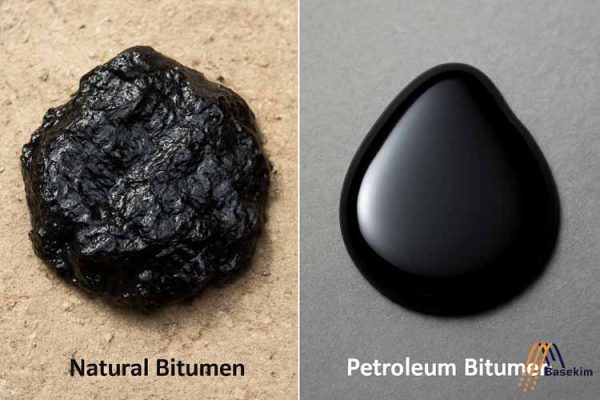
Natural bitumen and petroleum bitumen differ primarily in their formation, composition, and physical behavior. Natural bitumen, also known as mineral bitumen, is extracted directly from bitumen deposits and formed over millions of years as crude oil undergoes slow geological transformation. However, petroleum bitumen is produced in refineries as a byproduct of crude oil fractionation.
Because of their distinct origins, the two types of bitumen differ significantly in chemical composition, purity, oil content, saponification value, acidity, physical properties, typical applications, production methods, and even pricing. In this article from the Basekim blog, we will look at each of these differences and explain them in depth.
What Is Natural Bitumen?
Before comparing natural and petroleum bitumen, it’s important to know what each is. Natural bitumen is a type of bitumen formed over millions of years as organic materials buried deep underground gradually degrade. By the time it is extracted, it is typically solid or semisolid.
Natural bitumen contains a high concentration of heavy hydrocarbons and mineral compounds. This distinctive composition makes it denser, harder, and more resistant to oxidation than petroleum bitumen.
Application of Natural Bitumen
Natural bitumen and petroleum bitumen differ significantly in terms of practical applications. Mining naturally occurring hydrocarbon deposits yields natural bitumen, which is one of the oldest known forms of bitumen. Its hardness, chemical stability, and exceptional durability make it useful in a variety of industries. Its primary uses include:
- Manufacturing high-strength, long-lasting asphalt for road construction.
- Waterproofing buildings, foundations, and other industrial structures.
- Producing paints, anti-corrosion coatings, and sealing materials.
- Enhancing the quality, strength, and resistance of petroleum bitumen when combined with it.
What Is Petroleum Bitumen?
Petroleum bitumen is a thick, sticky hydrocarbon material formed during the refining of crude oil. It is essentially the remaining residue from the crude oil distillation process. Petroleum bitumen, depending on its chemical and physical properties, it is widely used in road construction, waterproofing systems, and the production of various bitumen-based products.
Different types of petroleum bitumen
Different grades of petroleum bitumen are designed for specific industrial applications such as asphalt production, insulation, sealing, and construction. Some common types are:
- Penetration Bitumen (e.g., bitumen 60/70) for asphalt mixtures and road surfaces
- Oxidized Bitumen for Waterproofing, Roofing, and Insulation
- Bitumen Emulsion for Cold Mix Applications
- Cutback bitumen (e.g., bitumen MC30) for specialized construction tasks.
In refineries, crude oil is heated in distillation towers to separate lighter fractions such as gasoline, kerosene, and diesel. The dense residue left behind is petroleum bitumen, which can be modified for use in specific industrial applications.
Petroleum bitumen distillation process
In refineries, crude oil is heated to high temperatures inside a distillation tower, causing lighter fractions like gasoline, kerosene, and diesel to evaporate and separate. What remains at the bottom is a dense, heavy residue containing complex hydrocarbons. This residue is collected as bitumen. Depending on the intended application, it may then be further processed, modified, or oxidized to achieve the desired performance characteristics for various industrial uses.

Difference Between Natural Bitumen and Petroleum Bitumen
Bitumen exists in two primary forms: natural (mineral) and petroleum, each with distinct chemical and physical properties that define their applications in various industries. Below, we break down the key differences between natural and petroleum bitumen.
-
Sulfur Content
One of the most noticeable differences between natural and petroleum bitumen is the sulfur content. Natural bitumen typically contains 3% to 8% sulfur because it forms in underground deposits that have been enriched with sulfur compounds over millions of years through geological processes.
Petroleum bitumen, on the other hand, typically contains less than 3% sulfur due to the removal of many impurities during crude oil refinement and distillation.
-
Purity Level
Petroleum bitumen is generally higher in purity. The refining process results in a controlled composition with significantly fewer impurities. Natural bitumen, on the other hand, is richer in mineral substances and inorganic compounds, which can affect its behavior and physical characteristics.
-
Oil Content
Another important point of comparison between natural bitumen and petroleum bitumen is oil content. Petroleum bitumen contains more light and volatile oils, resulting in greater flexibility and adhesion. Natural bitumen has a lower oil content, making it harder and more brittle, which is why it is widely used in applications requiring rigidity or waterproofing.
-
Saponification Value & Acid Content
Natural bitumen has a higher saponification value and acid content due to its complex mineral makeup. These properties influence its adhesion and chemical interactions with water and other materials. Petroleum bitumen’s more uniform chemical structure results in lower saponification activity and more predictable behavior in industrial applications.
-
Price Comparison
Petroleum bitumen is typically less expensive because it is produced in large quantities using standard refinery processes. Natural bitumen is more expensive due to limited sources, complicated extraction, and specialized industrial applications.
-
Extraction Methods
Natural bitumen is extracted directly from solid or semi-solid deposits. After mining, it is thermally and mechanically processed to make it commercially viable. Petroleum bitumen is fundamentally different: it is produced in refineries by distilling crude oil. It can be processed further to produce penetration bitumen, oxidized bitumen, emulsions, and other types.
-
Chemical Composition
Natural bitumen has higher concentrations of sulfur, heavy metals, and mineral compounds. Petroleum bitumen is primarily composed of aromatic and saturated hydrocarbons, with significantly fewer mineral impurities. Petroleum bitumen’s uniform composition makes it ideal for engineering applications that require predictable performance.
-
Physical Properties
The physical behavior of natural bitumen and petroleum bitumen differs significantly:
Natural bitumen is harder, more brittle, and has a higher softening point.
Petroleum bitumen is more flexible and adhesive and performs better at lower temperatures due to its consistent chemical composition.
The presence of impurities in natural bitumen can also result in variable performance under certain conditions.
-
Applications
Petroleum bitumen is commonly used in road construction, waterproofing systems, bituminous membranes (such as isogam), and asphalt manufacturing. Its high adhesion, flexibility, and uniform composition make it ideal for creating long-lasting and waterproof surfaces in construction and civil engineering.
-
Processing Costs
Petroleum bitumen typically has lower processing costs because it is produced on a large scale using standardized refinery processes. However, depending on the final application, there may be additional costs for chemical modifications or performance-enhancing additives.
Natural bitumen, on the other hand, is typically more expensive to produce. Its extraction is more difficult, frequently necessitating mining, mechanical processing, and purification to make it suitable for industrial use. These extra steps contribute to a higher overall cost than petroleum bitumen.

Conclusion
To summarize, natural bitumen and petroleum bitumen both have unique properties that make them suitable for a wide range of industrial and construction applications. Natural bitumen is distinguished by its hardness, durability, and high sulfur content, making it ideal for specialized projects, whereas petroleum bitumen offers superior flexibility, adhesion, and cost-effectiveness, making it the preferred choice for road construction, waterproofing, and general engineering purposes.
Basskim provides high-quality, dependable bitumen products for all of your project needs. Explore our selection today and purchase with confidence.