
Table of Contents
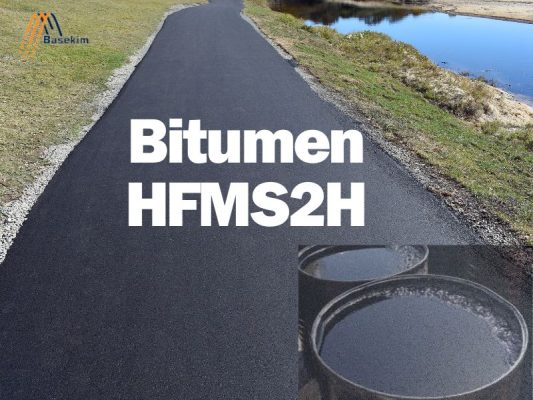
Bitumen HFMS2h
Bitumen HFMS2h serves various purposes based on its breaking characteristics. Rapid-setting emulsions are tailored for surface dressing, while medium or slow-setting ones are ideal for mixtures blended with aggregate in concrete-type mixers or in situ applications. Rapid-setting emulsions aren’t suitable for mixtures as they might solidify and obstruct the mixer during the blending process. Typically, finer aggregates require slower-setting emulsions. Hence, stone mixtures necessitate medium-setting emulsions and sand mixtures require a slow-breaking emulsion. The breaking process in anionic emulsions, mainly through water evaporation, makes them sensitive to temperature and humidity, affecting their breaking properties.
Download the Specification of Bitumen HFMS2h
MSDS of Bitumen HFMS2h
Anionic Emulsions in Industrial Coatings
Anionic emulsions, characterized by a negative charge, are extensively researched in the Industrial coating industry due to their prevalence and potential. However, when anionic emulsions are combined with cationic emulsions, they form strong bonds that transform the substance into a solid. Despite this strength, it’s not ideal for coatings as they can’t be applied to substrates effectively.
Application of Bitumen
HFMS-2h is a slow-setting cold bitumen emulsion used for waterproofing applications. It’s created through a process involving bitumen, special emulsifiers, water, and additives in a high shear rate colloid mill. This product is specifically designed for waterproofing and building applications, including concrete and metal surfaces. Bitumen HFMS2h is a high flash point and low solvent content make it user-friendly and safe. HFMS-2h can be applied using various methods like a painting brush, squeegee, airless spray, or roller.
Packaging of HFMS2h
The packaging of HFMS-2h involves placing it in thick steel drums on pallets to prevent leaks during transportation. Additionally, Bitumen HFMS2h is available in bulk packaging in bitutainers and tankers, ensuring safe and convenient storage and distribution.
Specification
|
PROPETRY |
MIN |
MAX |
TEST METHOD |
|
Viscosity SSF , 25 °C (s) |
100 |
— |
ASTM D244 |
|
Storage stability, 24h (%) |
— |
1 |
ASTM D6930 |
|
Particle charge test |
Minus |
ASTM D244 |
|
|
Sieve (%) |
— |
0.1 |
ASTM D6933 |
|
Residue by distillation (%) |
65 |
— |
ASTM D244 |
|
Residue penetration, 25 °C |
40 |
90 |
ASTM D5 |
|
Residue ductility, 25 °C, 5cm/min (cm) |
40 |
— |
ASTM D113 |
|
Solubility in trichloroethylene % |
97.5 |
— |
ASTM D2042 |
|
Float of residue. 60 °C (s) |
1200 |
ASTM D139 |
|
Title: Unveiling the Potential of Anionic Bitumen Emulsion HFMS-2h
Meta Description: Discover the unique properties and versatile applications of anionic bitumen emulsion HFMS-2h, from its cold/non-fiberated liquid form to its efficient waterproofing capabilities. Explore how this product is produced and packed for optimal use in various construction projects.