
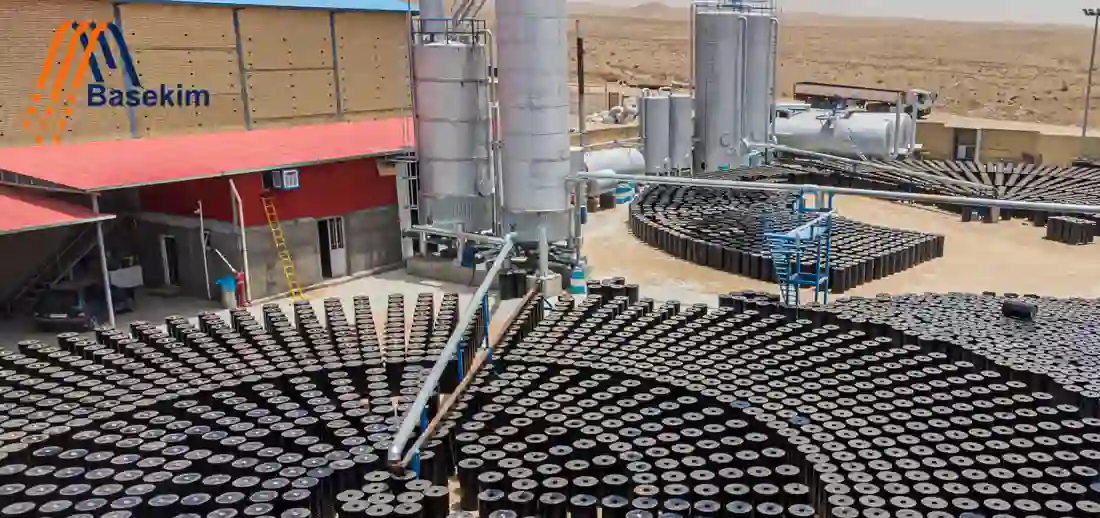
The bitumen production process turns crude oil into a strong binder for roads, roofs, and waterproof materials. Every stage works under strict heat and pressure control to ensure the final product stays stable and safe.
Basekim, a trusted bitumen supplier from Turkey and the UAE, follows international standards to produce and export top-quality grades worldwide.
Step 1: Crude Oil Desalting
The process starts when engineers send crude oil into a desalting unit. They wash out water, salts, and small solids before heating begins.
Because salt can corrode pipes, removing it early protects equipment and improves the next steps. As a result, the feedstock stays clean and ready for precise distillation.
Step 2: Atmospheric Distillation
Next, the clean oil enters the atmospheric distillation unit (ADU). Inside, heaters raise the temperature to about 370 °C.
Light products like naphtha, kerosene, and gas oil rise to the top, while heavy fractions settle at the bottom. This heavy stream, called atmospheric residue, becomes the base for further refining.
Step 3: Vacuum Distillation
Then the atmospheric residue flows into the vacuum distillation unit (VDU). Engineers lower the pressure to let separation happen at lower temperatures.
Because the system avoids cracking, the heavy molecules remain strong. The product that stays behind is the vacuum bottom, the main feed for bitumen.
At this stage, technicians monitor t
emperature (400 °C) and pressure (25–40 mmHg) to keep viscosity and softness consistent.
Step 4: Air Blowing (Oxidation)
Now the vacuum bottom moves to the air-blowing reactor. Hot air passes through it at around 250 °C, and oxygen reacts with the oil.
These reactions increase molecular weight and raise the softening point. The result is oxidized bitumen, perfect for roofing and waterproofing.
Operators track viscosity in real time and stop the reaction exactly when the bitumen reaches its target grade.
Step 5: Cooling and Filtration
After oxidation, the hot product flows through heat exchangers to cool down. Then it passes through fine filters that trap carbon and solid residues.
Because the filters clean every particle, the bitumen gains a smooth, stable texture. This step keeps the quality consistent for storage and export.
Step 6: Storage and Blending
Next, the bitumen enters insulated steel tanks equipped with heating coils and level sensors. The tanks keep the material between 150 °C and 180 °C.
Engineers often blend different batches to match required penetration or viscosity.
For higher performance, they may add SBS or EVA polymers, creating polymer-modified bitumen (PMB) that performs better under heat and traffic stress.
Step 7: Packaging and Export
Once laboratory tests confirm that the bitumen meets ASTM and EN standards, Basekim prepares it for delivery.
Packaging options include:
-
Steel drums (150 kg)
-
Jumbo bags (1 MT)
-
Meltable PE bags (20–25 kg)
-
Bulk tankers and ISO containers
Because Basekim runs modern filling and inspection systems in Turkey and the UAE, every shipment stays safe, sealed, and uniform.
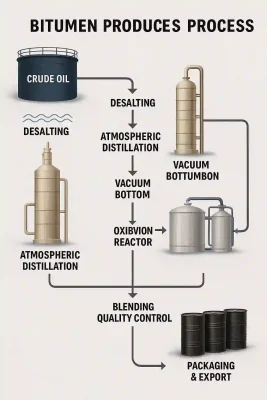
Bitumen Production Process Flow Diagram
Here’s a clear outline of the bitumen production process flow diagram:
Link with Asphalt Production Process
After production, bitumen becomes the key material in the asphalt production process.
At asphalt plants, it mixes with aggregates at 160 °C to form hot asphalt. Because pure bitumen offers strong adhesion, it locks stones together and keeps roads smooth for years.
Therefore, quality control at the refinery directly affects pavement life.
Green Technology and Innovation
Modern refineries use energy-saving burners, fume-capture systems, and recycled heat recovery to protect the environment.
In addition, engineers develop bio-based binders and recycled asphalt blends to cut emissions.
Basekim also applies AI-based viscosity monitoring, which reduces energy waste and keeps product consistency at the highest level.
Conclusion-Bitumen Production Process
The bitumen production process combines chemistry, heat, and precision. Each controlled step turns crude oil into a strong and flexible binder.
With modern technology and international quality standards, Basekim — from Turkey and the UAE — supplies reliable bitumen grades for road construction, waterproofing, and industrial projects around the globe.